The return on investment from custom software is not always obvious at first.
That is because many businesses focus only on the build cost.
They ask, “How much will this software cost?”
That is a fair question. Money does remain annoying and necessary.
But the better question is:
How much is the current process costing us?
A bad process has a cost. It may not show up as one clean line item, but it is there.
It shows up in staff hours. It shows up in mistakes. It shows up in missed follow-ups, duplicated work, slow reports, customer frustration, and leadership making decisions with incomplete information.
Custom software can create ROI by reducing those hidden costs.
Manual work is expensive
Manual work feels normal because many businesses have been doing it for years.
A staff member updates a spreadsheet. Someone sends reminder emails. Someone exports a report. Someone checks the payment status. Someone copies information from one system to another. Someone manually creates a monthly summary.
Each task may only take a few minutes.
But repeated across a team, every week, those minutes become expensive.
A custom software system can automate repetitive steps, including:
- Customer intake
- Internal task creation
- Payment status updates
- Reminder emails
- Document collection
- Approval workflows
- Staff notifications
- Monthly reports
- Customer status updates
- Scheduling handoffs
The point is not to replace people. The point is to stop wasting people on tasks that software can handle.
Humans are inconsistent, emotional, distractible, and occasionally brilliant. Software is boring, fast, and does not complain about copying data at midnight. Use each accordingly.
Better data creates better decisions
Many business owners operate with partial visibility.
They know sales numbers, but not bottlenecks.
They know revenue, but not where jobs are getting stuck.
They know staff are busy, but not which tasks are eating the most time.
They know customers are frustrated, but not where the process is failing.
Custom software can help by collecting the right data during the normal workflow.
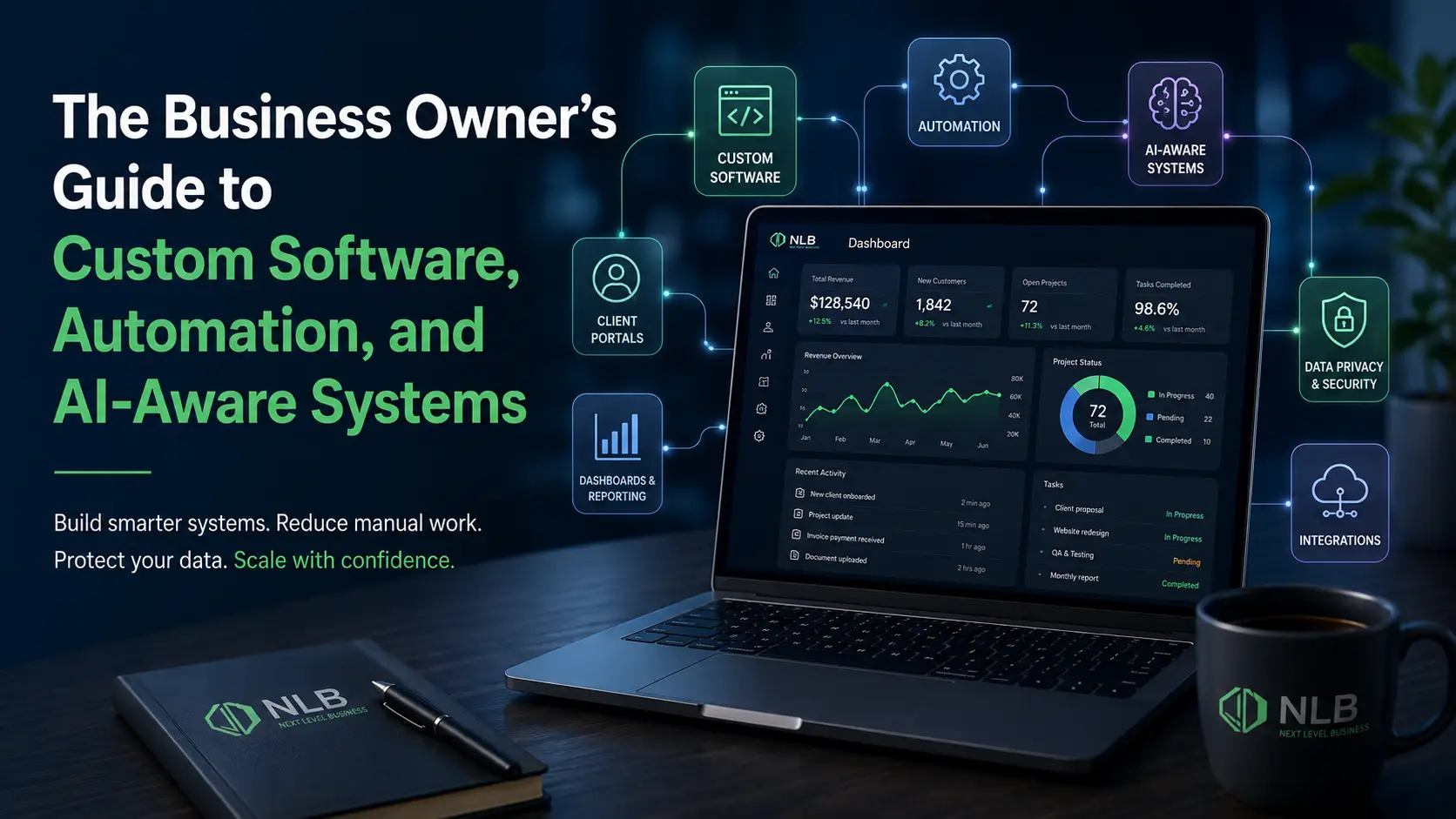
Instead of asking the team to create reports manually, the system can track activity in real time. That means dashboards can show useful information in real time.
Examples include:
- New leads by source
- Open jobs or projects
- Revenue by product or service
- Unpaid invoices
- Customer requests
- Average response time
- Staff workload
- Completion time
- Approval delays
- Support volume
- Customer portal activity
This type of visibility helps owners make better decisions because they are not guessing from scattered information.
Software can reduce customer friction
Customer experience is often an operations issue.
A customer may not know your internal process is broken. They just experience the symptoms.
They wait too long for updates.
They send documents twice.
They do not know what happens next.
They call for information that should have been available online.
They get inconsistent answers from different staff members.
Custom software can reduce that friction.
A portal can let customers log in, upload documents, view updates, make payments, approve work, request support, or check status without calling or emailing.
That improves the customer experience while reducing staff workload.
This is one of the best types of ROI because it helps both sides at once. Customers feel more informed, and staff spend less time answering repetitive questions.
Custom software can connect disconnected systems
Many businesses do not need one giant system that does everything.
They need key systems to work together.
Custom software can connect:
- Website forms
- CRMs
- Payment processors
- Email systems
- Scheduling tools
- File storage
- Internal dashboards
- Customer portals
- Inventory systems
- Reporting tools
- Mobile apps
This can reduce duplicate data entry and make the business easier to manage.
The goal is not always to replace every tool. Sometimes the smartest move is to keep the tools that work and build custom software around the gaps.
That is usually more practical than burning everything down and starting from scratch, which is a strategy humans keep trying for reasons historians may never fully explain.
Security and governance affect ROI, too
Security is not usually the reason a company first considers custom software.
But it should be part of the conversation.
IBM’s 2025 Cost of a Data Breach Report lists the global average cost of a data breach at USD $4.4 million and emphasizes that AI adoption without proper security and governance can increase risk.
Most small and mid-sized businesses are not trying to build enterprise security programs overnight. But they do need practical controls.
That can include:
- Strong user roles
- Limited staff access
- Secure authentication
- Audit logs
- Data backups
- Encryption where appropriate
- Better handling of customer records
- Clear rules around AI and automation
- Reduced reliance on random spreadsheets and shared passwords
Bad systems often create bad security habits.
When staff cannot easily access what they need, they create shortcuts. They share files, reuse passwords, export customer lists, or store information in places it does not belong.
A better system can reduce those risky habits.
The best ROI comes from solving the right problem
Custom software does not create ROI just because it exists.
It creates ROI when it solves an expensive problem.
That problem might be:
- Too much manual admin work
- Poor customer experience
- Missed follow-ups
- Slow reporting
- Disconnected tools
- Expensive software subscriptions
- Staff confusion
- Weak visibility
- Compliance or privacy concerns
- A process that cannot scale
Before building anything, the business should define the operational problem, clearly.
A good discovery process should answer:
- What is broken?
- Who is affected?
- How often does it happen?
- How much time does it waste?
- What mistakes does it cause?
- What would improve if this were fixed?
- What does the system need to do now?
- What might it need to do later?
That keeps the project focused on business value instead of random features.
Final takeaway
Custom software should not be treated as a shiny technology purchase.
It should be treated as an operational investment.
When done well, it can reduce manual work, improve the customer experience, improve reporting, connect systems, strengthen controls, and give the business more room to grow.
The ROI comes from replacing friction with flow.
That is the real value.
Next Level Business helps companies turn messy processes into cleaner software systems, including portals, dashboards, automation tools, integrations, and custom business platforms.